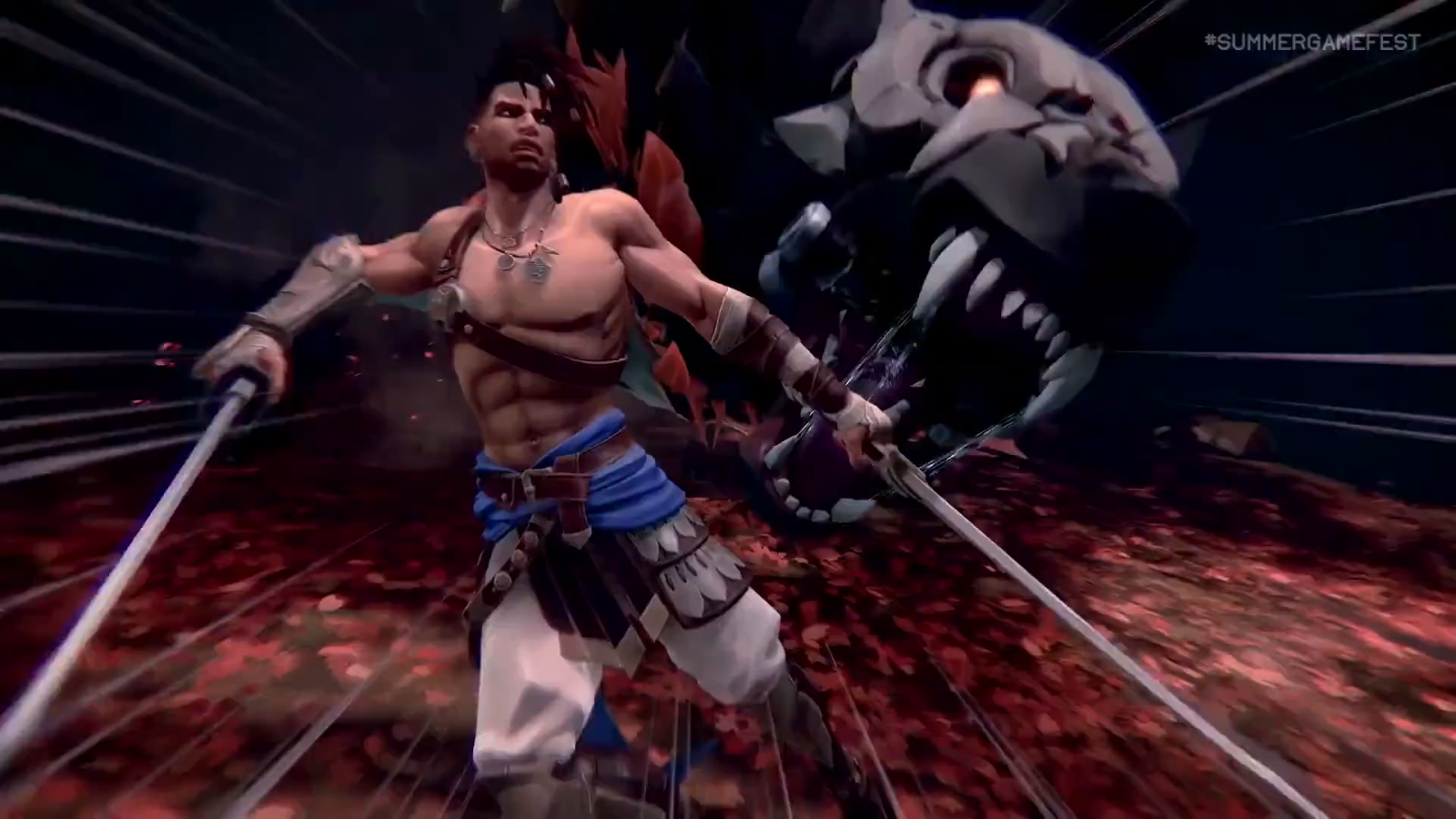
Considering the whole debacle surrounding the Prince of Persia: The Sands of Time remake that has been in the works at Ubisoft, it genuinely surprised me to see Summer Game Fest Live kick off with an entirely new Prince of Persia experience, especially since Ubisoft didn't wait a few days to announce the game at its own dedicated live showcase. But regardless of that, Prince of Persia: The Lost Crown has been announced, and with this being the case, the French publisher has let media get hands on with the upcoming platformer on both PC and Nintendo Switch, in a build that has been marginally altered from the intended version players will be seeing at launch.
Immediately from the beginning, you get the impression that The Lost Crown is a Prince of Persia game through and through. It's set in a fantastical and supernatural take on the land of Persia, a place where humans with incredible abilities exist and gods and monsters live amongst the mortals. Adding to this is the core gameplay style, which is that of a 2D platformer with Metroidvania elements, and yes, this means there is a lot of leaping across gaps, bounding up walls and ledges, evading dangerous traps and hazards, all on top of overcoming and defeating enemies using the quick-paced combat suite. The main catch with The Lost Crown however, is that you don't actually play as the Prince of Persia, but rather that of an individual known as Sargon, a member of a group known as the Immortals who have been tasked with heading into a region of Persia devastated by time anomalies to find and save the taken Prince.
The level design of The Lost Crown is very typical Metroidvania. There are lots of nooks and crannies in a seamless world that you can discover and explore to find secrets, new enemies, items and so forth, but as you'll need to improve Sargon's skills as the storyline progresses, there will be areas that are not traversable from minute one. If you've played {Metroid, Castlevania, Blasphemous}, hell, even read my recent Disney Illusion Island preview, The Lost Crown feels very, very similar with how it operates at a fundamental level. But that's not to say that the fluid movement systems aren't a blast to muck around with. The parkour and abilities that have coined the Prince of Persia series feel present here once again, and work well to prevent the level design itself from feeling too familiar to the rest of the sub-genre. I will say, from an aesthetic standpoint, the levels in The Lost Crown are very striking and do deliver on the promise of a mythological Persia.
But anyway, onto the combat. As this is a 2D game, the combat is more about reactions and positioning over just relentlessly swinging away like a 3D action game. You have to careful and wise with how you tackle even the most basic enemies, as Sargon isn't incredibly resistant to hits and will find himself on death's door after a few mistimed actions. To help overcome threats, you can use leaps, dodges, and slides to evade attacks as well as landing perfectly timed parries to block and stun attacking foes leaving them open to your slashing assaults. In terms of aggressive moves, Sargon can use his dual-swords to unleash a flurry of strikes, and then can sprinkle in ranged attacks with a bow and even use a ranged charged up spinning blade to inflict additional strikes. Then there are the Time Powers, which are powerful special moves that cause tons of damage or help aid Sargon in the heat of battle. For the preview build I tested two of these were at my disposal, with one being a sweeping and stunning action and the other being a bomb-like ability that spawns a healing pool at its casted location. The catch with these moves is that Sargon will need to build up energy to be able to use them, with some even costing more energy than others meaning you have to think about which suits the combat occasion.
The Lost Crown does have progression systems beyond simply finding more core abilities and items for Sargon. These include acquiring currency that can be spent at vendors to buy or improve new weapons for combat or even make Sargon's healing potion more effective. You can also come across different Amulets that act as gameplay modifiers and alter and differ Sargon's abilities and moves, for example, getting a bit of health back with every successful parry or changing bow attacks from single-shot to tri-shot.
It should be said here that The Lost Crown is not an easy game. It's not massively demanding either, but in a typical Metroidvania fashion, it will require a bit of skill and a lot of learning to become familiar with the gameplay systems and the fast-paced nature of the experience. But it's rewarding when you defeat challenging bosses (such as the manticore type foe that I came across during the demo, who ended up besting me three times before I managed to overcome it) and it feels thrilling to play, and that's a by-product of the challenge that The Lost Crown poses.
As I did also get the chance to play The Lost Crown on both PC and Switch, I want to just note as well about how well this game suited Nintendo's platform. The world looks more vibrant and deeper on a big monitor and being powered by a more powerful piece of hardware, but Nintendo's platform seemed to offer great performance and didn't detract from the experience with its smaller resolution and limited performance. Come launch in January 2024, the Switch seems like the platform to play The Lost Crown on in my opinion so far.
But all in all, Prince of Persia: The Lost Crown is shaping up to be a really interesting return to the world of Prince of Persia. It's fast-paced and thrilling and seems to nail the promise and style that the series was once known for, before it made its leap to 3D. While Ubisoft has a very busy second half of 2023, it's clear that the French publisher will be starting 2024 off with a bang as well.